

What is Memory-Based Billing?
Memory-based billing occurs when employees of a professional services firm wait until the end of a reporting period to "remember" their work and fill out timesheets. Because human memory is not indestructible, this leads to two destructive outcomes:
- Under-reporting: Forgetting the "quick" 15-minute client calls, emails, or WhatsApp conversations that add up to hours of lost revenue.
- Inaccuracy: Rounding down to avoid client disputes or rounding up and risking a loss of credibility during audits.
Does your firm suffer from "Friday Afternoon" Syndrome?
Most professionals treat time entry as a "Friday afternoon" administrative chore. By then, the nuances of Monday's projects are gone. This creates a "revenue fog" where leadership lacks visibility into true project costs, and employees feel the burnout of "invisible work" that never makes it to a bill. It is a silent profit-killer.
If you feel more than 15% of your revenue is leaking away, then it is a matter of concern. The "why" behind it is a complex mix of human psychology, administrative friction, and the nature of modern professional work. To solve the problem, professional services firms must first understand the specific ways memory-based billing sabotages their operations.
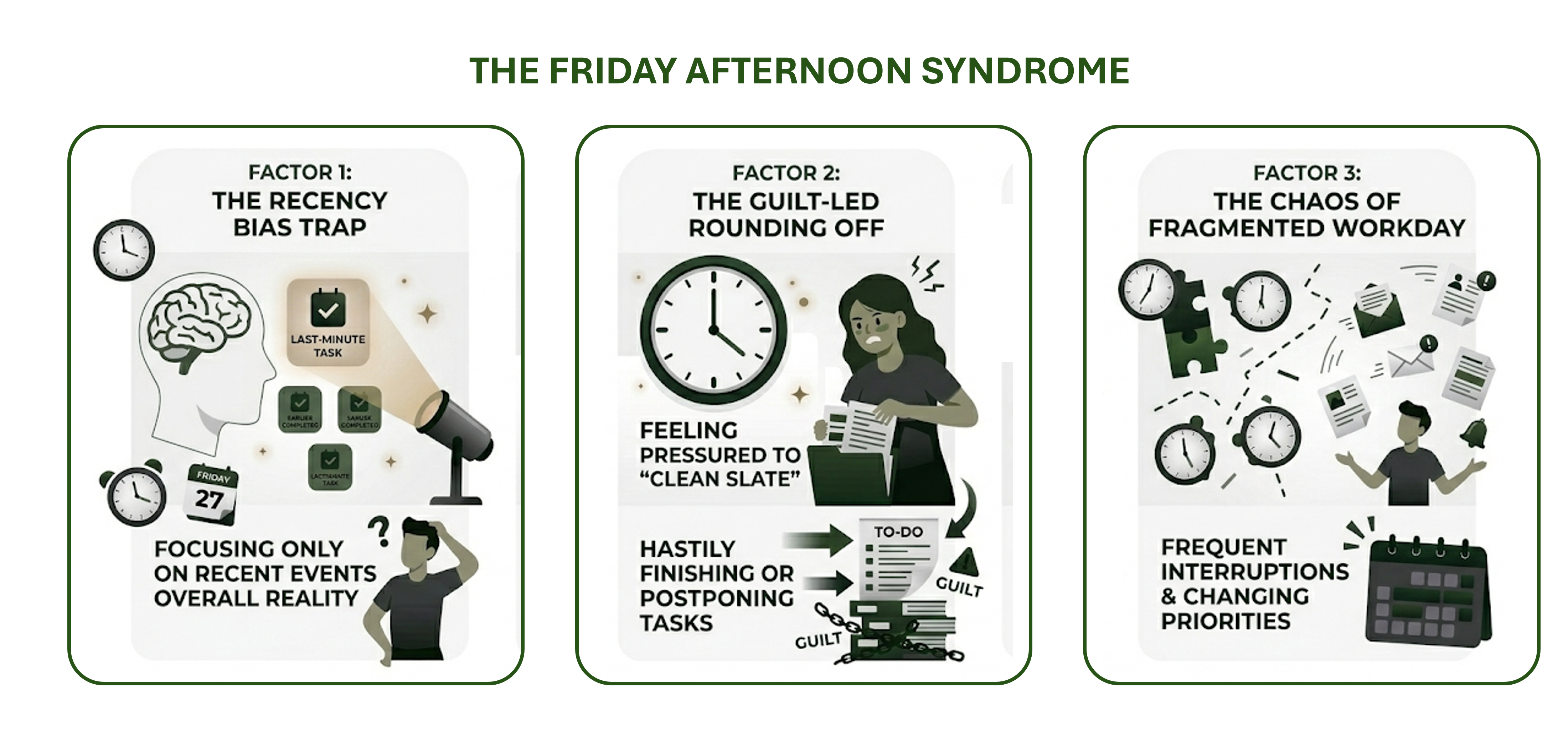
1. The Recency Bias Trap
Human memory is naturally wired for Recency Bias, which is the tendency to remember the most recent events more clearly than those further back.
So, when your employee a consultant sits down on Friday afternoon to log their week, the Monday activities are often a blur. They might refer to their calendar for the meetings that were scheduled or the quick discussion with a senior stakeholder from the client, but they might completely forget the three 20-minute follow-up tasks that happened immediately after.
The Result: The "tails" of the projects – the planning phase and the follow-up – are frequently lopped off, leading to a consistent under-reporting of true effort.
2. The Guilt-Led Rounding Off
When professionals are not 100% sure how long a task took, they tend to round it down out of professional guilt or fear of client pushback.
Even a seemingly small task of writing an email to the client might actually take up to 30 minutes, depending on how complex the topic is. Also, they might not want to be seen by others as someone who is "slow" or incompetent" who took 30 minutes to do something that could have taken just five minutes.
It is not 30 minutes lost. When an entire firm of 50 people "self-discounts" just 30 minutes a day, the firm loses 6,250 billable hours per year.
3. The Chaos of Fragmented Workday
Modern professional services are no longer easily compartmentalised. Work does not happen in neat, two-hour blocks. Multiple projects are to be executed simultaneously. Work is fragmented across emails, WhatsApp, and Teams. Client check-ins take place while commuting or between meetings. A professional has to manage three different clients in a single hour. Of course, time tracking is not easy.
Memory-based billing is physically incapable of capturing this micro-work. Without a real-time system, these "micro-interactions" are treated as overhead rather than the billable expertise they actually represent.
What is the impact of Memory-based Billing?
The consequences of memory-based billing extend far beyond a few missed minutes.
- •Direct "billable leakage" of 15–20% acts as a 20% tax on your gross margin and directly impacts project profitability.
- •Memory-based logs are often delayed, leading to late invoicing and higher Days Sales Outstanding (DSO).
- •Vague descriptions like "Worked on project" lead to invoice disputes and uncomfortable "please justify this" conversations.
- •The problem is not just financial but also informational. When hours are "guessed", the data becomes junk data. It will lead to the subsequent estimates being inaccurate.
- •Memory-based billing hides the fact that certain clients or service lines are actually costing the firm money due to uncaptured efforts.
- •Memory-based billing creates an enormous administrative "tax." Project Managers have to spend hours chasing their staff to fill timesheets, Finance Teams have to verify "best guesses" again before an invoice can be sent, and Partners spend valuable time editing vague descriptions so they are understandable and acceptable to the client.
Which industries are impacted the most by Memory-based Billing?
While all service firms struggle with memory-based billing, certain sectors face higher risks due to their billing structures:
Chartered Accountancy
There are several quick advisory calls that usually go unbilled.
Legal Services
Billing in 6-minute increments is standard and missing two short calls a day can lose thousands in annual revenue per associate.
IT & ITeS
While software development cycle is tracked efficiently using tools such as Jira and GitLab, the hours spent on servicing aspects such as project planning, requirement gathering, hypercare period, incident management, and AMC services usually slip through the cracks.
Consulting
High-velocity environments where multi-tasking across several clients makes mental reconstruction nearly impossible.
Architecture & Engineering
Long-term projects often suffer from "scope creep" that goes unlogged because it feels too "small" to record at the week's end.
Marketing & Creative Agencies
Often under-report the "thinking time" and revisions that happen outside of formal meetings.
What are the best practices to eliminate guesswork?
To move away from memory-based billing, firms must shift from reconstruction to capture:
- 1Track in the Moment:
Adopt a "log as you go" culture of attendance and time-tracking. Even a 30-second entry during a task switch is more accurate than a Friday guess.
- 2Capture Non-Billable Time:
Employees need to understand that the total "cost of delivery" requires tracking internal work alongside client work.
- 3Use Activity-Based Codes:
Assign time to specific tasks or milestones, not just "general", to provide transparency to clients.
- 4Standardize Rounding:
Use automated rules (e.g., rounding to the nearest 10 or 15 minutes) to ensure consistency across the firm.
- 5Use a PSA Software:
Replace the practice of using registers and spreadsheets to record attendance and time with a professional services automation software.
How does a PSA Software solve the problem?
Professional Services Automation (PSA) software replaces the "guesswork" with a single source of truth. Unlike manual spreadsheets, a PSA tool integrates time tracking directly into the project management workflow and gives the management a real-time view of timesheets of their employees.
PSApulse is one of the most comprehensive PSA softwares with useful features such as:
- Real-Time Timers: One-click timers allow staff to start and stop tracking as they switch between client tasks.
- Live Data Capture: Real-time tracking plugs leaks instantly, ensuring every minute of expertise is captured and invoiced.
- Automated Suggestions: Can integrate with calendars and emails to "remind" users of work they might have forgotten to log.
- Direct Invoicing: Logged hours flow directly into the billing engine, reducing the "time-to-invoice" and eliminating manual data-entry errors.
- Leakage Analytics: Dashboards highlight the delta between scheduled hours and logged hours, helping managers spot leakage before the month ends.
Firms that switch from manual, memory-based systems to integrated PSA platforms such as PSAPulse typically see an immediate 5–10% increase in billable utilization simply by capturing work that was previously "invisible."
Ready to Eliminate Memory-Based Billing?
Discover how PSApulse can help you capture every billable minute and boost your revenue.